

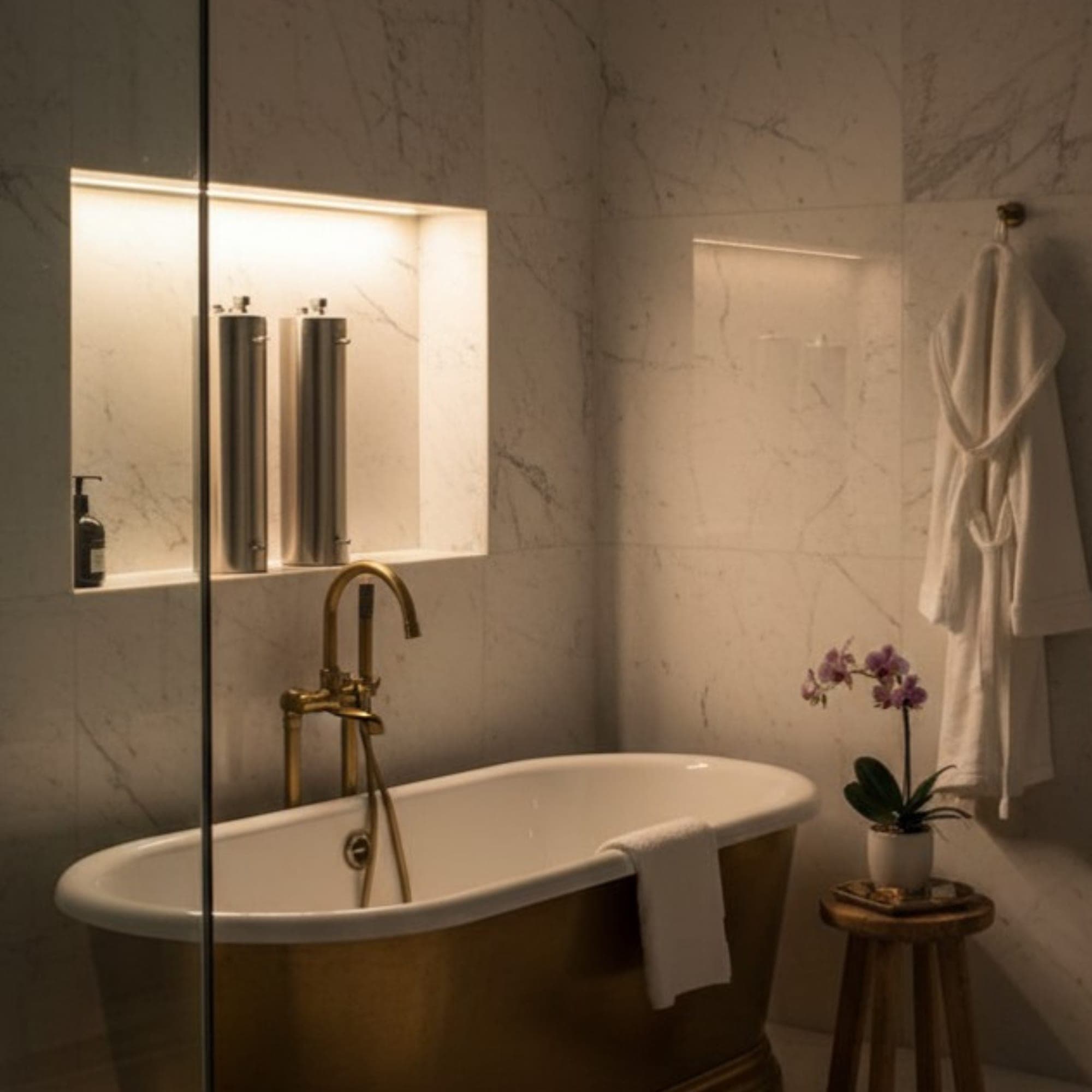
A homeowner who has chosen a Hansgrohe Axor shower is making an aesthetic statement about how the bathroom should feel. The decision involves trade-offs that are obvious — the price, the assembly time, the importation logistics — and one that is not obvious: the water the fitting is going to live on. Every premium fitting manufacturer ships products engineered for a feed-water envelope. Most Indian residential supply sits outside it.
The first eighteen months
For the first eighteen months, the fitting performs as expected. Chrome stays bright. Cartridge moves smoothly. Shower head delivers an even spray. The homeowner is happy. The architect is congratulated. The mineral deposit is invisible to the eye and not yet noticeable in flow rate.
Underneath, the chemistry is already at work. Calcium and magnesium are depositing on every wetted internal surface — the shower head's jets, the cartridge's sealing surfaces, the rubber gaskets at every joint. The deposit is microns thick at six months, tens of microns at a year, visible to the naked eye by month eighteen.
Year two: the cosmetic phase
In year two, the cosmetic phase begins. The chrome at high-splash zones dulls a half-shade. The shower head's spray becomes very faintly uneven. The lever stiffens by a barely-perceptible amount. The homeowner notices only on close inspection or when comparing against a photo from installation. The architect, if asked, will usually explain it as "patina" — which it is not. Patina is the predictable, intended ageing of bronze or copper. This is mineral deposit.
Year three: the functional phase
In year three, function starts to slip. The shower head's flow rate measurably drops as scale narrows the jets. The diverter develops a slow drip when off — the rubber seal hardened by cumulative chlorine exposure. The Hansgrohe cartridge, scaled internally, starts to require more force to move. The first replacement part order goes in.
The fittings are right. The water is wrong. The disaster is slow, and it is everywhere.
What the architect should have known
The decision to treat the water is most cheaply made before tile. A whole-house treatment system installed during the build adds a few percent to the bathroom budget and brings every tap inside the spec envelope of the fittings being installed. The same decision made post-tile — once the fittings are showing wear — costs the same in the system plus the replacement parts that have already aged out.
No premium-fittings brand will tell you their products fail on Indian water. They will, if asked, point at the feed-water specification page in the manual and explain that performance is conditional on the spec being met. The architect's job, increasingly, is to coordinate the water treatment as carefully as they coordinate the fitting selection. The two decisions are one decision.