

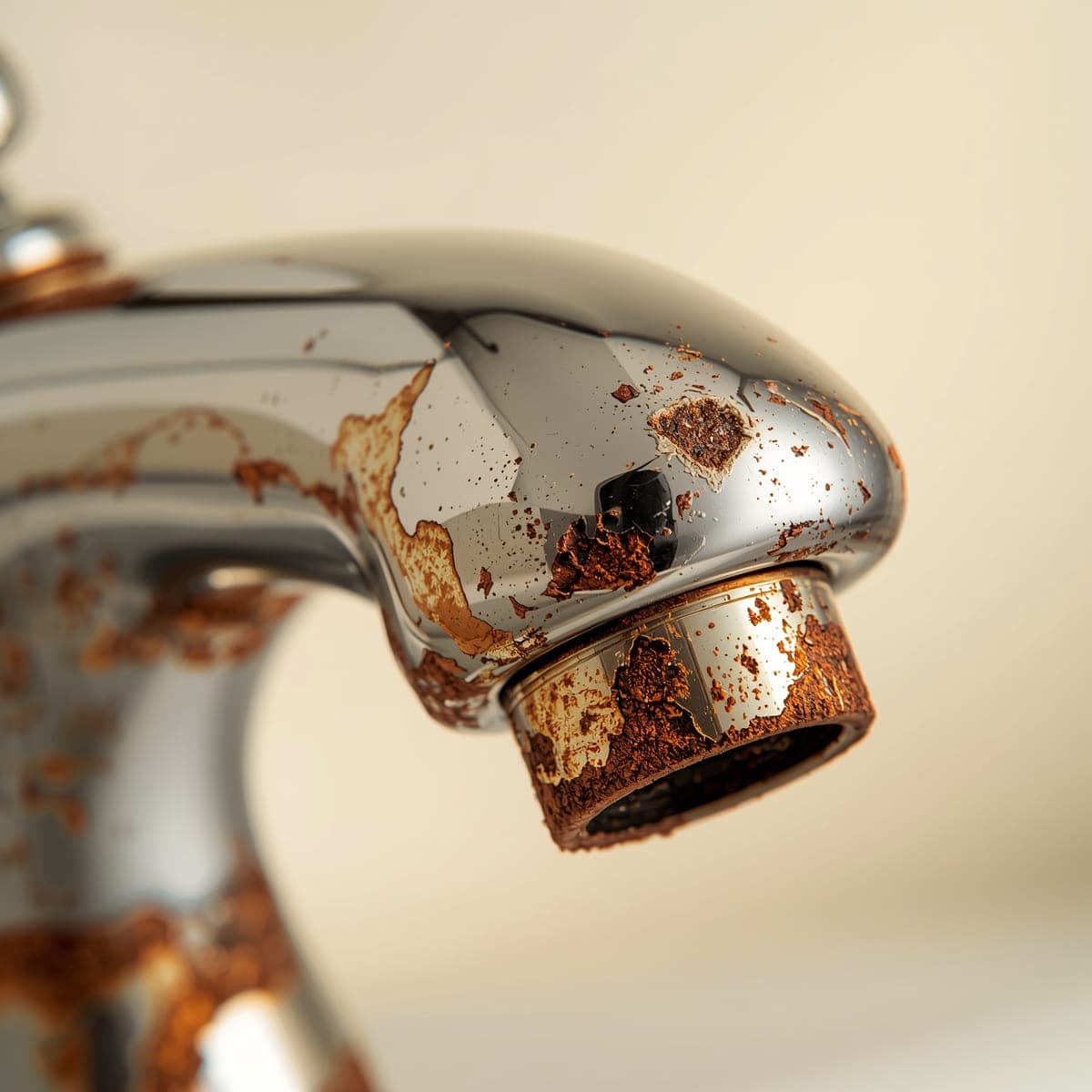
Most homeowners learn about iron the same way: a slow accumulation of small symptoms that, twelve to eighteen months in, stop being deniable. The marble grout near the WC takes an orange line. The bathroom's CP fittings dull a half-shade. A faint metallic note creeps into the kitchen tap, noticed first in tea and dal. None of this happens because the borewell suddenly worsened — borewell chemistry is remarkably stable year to year. The symptoms compound because nothing has been treating the iron the whole time.
Where iron comes from
Iron in residential borewells is dissolved as ferrous iron (Fe2+), invisible in water that is freshly drawn. It oxidises on exposure to air, converting to ferric iron (Fe3+), which is the orange-red form that stains tile grout, marble, and sanitaryware. The conversion happens within seconds of the water sitting in the bowl of a basin, the heater of a geyser, or against the porous edge of cement grout.
A borewell tested at 0.5 ppm iron — a level many homeowners assume is "negligible" — will, over a few years, lay down enough cumulative iron oxide to permanently alter the colour of grout, hard-water deposits, and any porous stone the water touches.
Why a softener alone will not solve it
A water softener — the most-installed treatment for residential hardness in India — uses ion-exchange resin to swap calcium and magnesium ions for sodium. Iron, in solution, can also bind to the resin. The problem is that ferric iron (the oxidised form) does not release back when the resin regenerates. It coats the resin beads and progressively destroys their capacity.
Iron destroys downstream resin. A softener after iron exposure clogs within months, not years.
In practice, a softener installed without iron pre-treatment on a borewell carrying 0.5 ppm or more iron will lose half its capacity inside a year. The customer notices the symptoms returning — scale on the geyser, hard-water feel — and assumes the system has failed. The system has not failed. The sequence was wrong.
The right order
On a borewell-fed home with any visible iron — yellow water, orange staining, metallic taste — the treatment train looks like this:
- —Sediment filter (catches the upstream silt that scratches downstream valves)
- —Iron filter (oxidises ferrous iron and traps the ferric form in media)
- —Activated carbon filter (removes residual chlorine and the summer chemical taste)
- —Softener (the decisive stage — only now that the resin is protected)
This is the HomeSoft four-stage train. It is the same sequence used in industrial WTPs and in commercial RO pre-treatment, scaled down to residential capacities. Skipping the iron stage is the single most common reason residential water systems fail in year two.
Before you treat: test
The ten-minute test that decides everything is the iron-spot test combined with a hardness and TDS reading. A free survey includes it. The number decides the media; the household draw decides the capacity. Without the test, you are guessing. With the test, you know.