

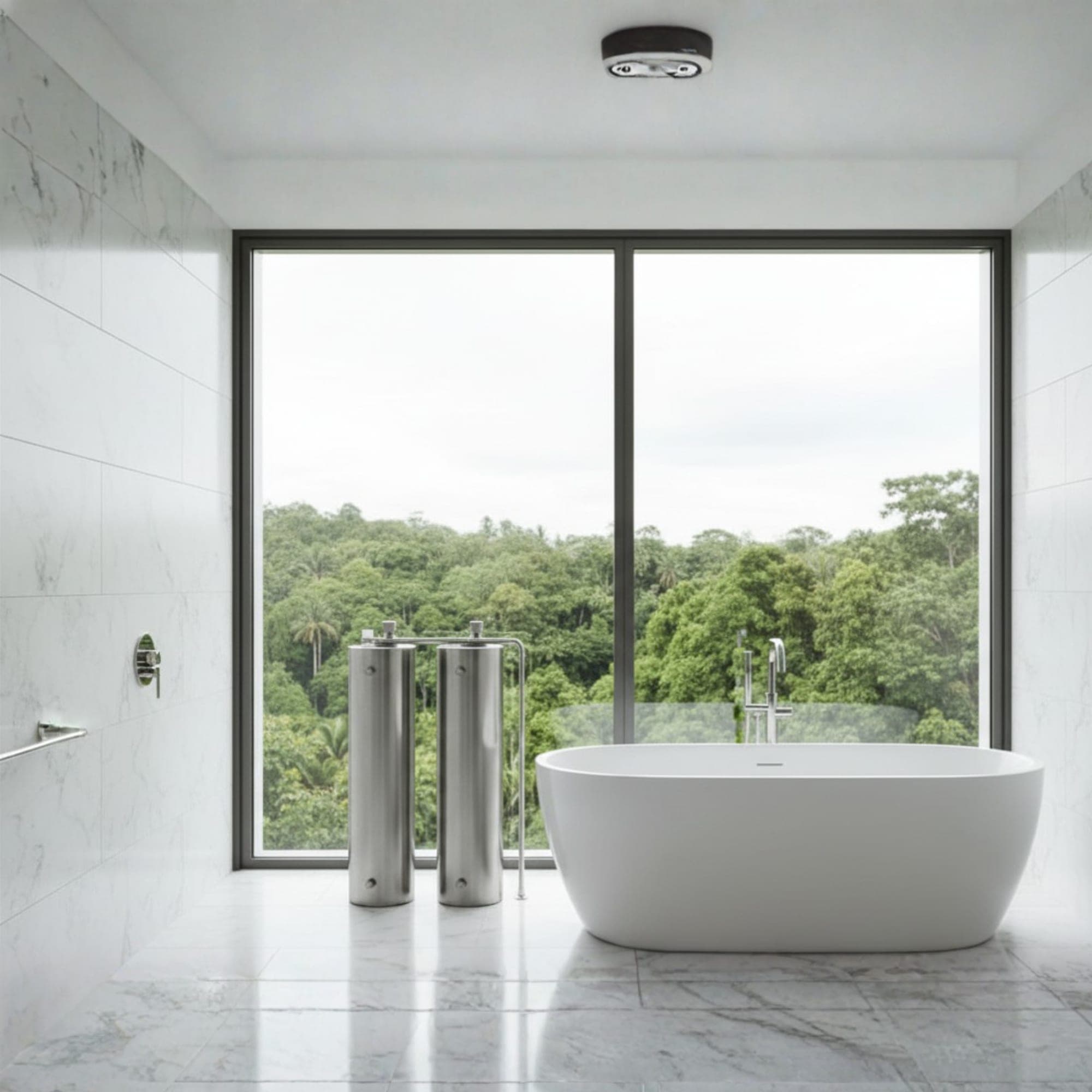
A homeowner who has spent two lakh on a Hansgrohe Axor shower assembly is not being unreasonable in expecting the chrome to look new for a decade. The brand exists, in part, because the chrome does look new for a decade — in Germany, in Belgium, in the parts of Singapore where municipal water is RO-polished. The fittings are engineered for a particular feed-water envelope.
What the spec sheet says
Premium European fittings typically assume feed water with hardness below 120 ppm, iron below 0.1 ppm, residual chlorine below 1 ppm, and pH between 6.5 and 8.0. Inside that envelope, chrome plating retains its finish, internal seals hold for two decades, and ceramic cartridges resist scaling.
Outside that envelope, the behaviour changes. Hardness above 180 ppm — common across NCR, Pune, and across most of borewell-fed urban India — deposits calcium carbonate on every wetted surface. Iron above 0.3 ppm leaves orange staining around the spout. Chlorine above 2 ppm — possible at the head of the municipal line in some cities — ages the rubber and silicone seals. None of this is a fault in the fitting. The fitting is performing exactly as designed, on water it was not designed for.
The cost of the mismatch
The first symptom is cosmetic. Chrome dulls. The shower head begins to spray unevenly as scale narrows the jets. Within two years, the mineral deposit becomes visible from across the bathroom — a faint whiteness around the spout, a haziness on the body of the shower handle.
The second symptom is functional. Ceramic cartridges scale internally; the lever stiffens. The shower head's flow rate drops noticeably. Then the seals: chlorine and hardness together harden the rubber, and the diverter starts to drip when off. By the four-year mark, a fitting that should look new is being quietly replaced one part at a time.
The fittings are performing exactly as designed, on water they were not designed for.
The architect's decision
The cleanest moment to address the mismatch is before tile. A whole-house treatment system installed during construction — sediment, iron, carbon, softening — brings every tap inside the spec envelope of the fittings the architect has specified. The cost is a few percent of the fittings budget. The benefit is that the fittings look, feel, and function the way the brand intended for the next two decades.
The expensive moment to address it is at year three or four — when the homeowner notices the chrome has lost its edge, and the fix involves not just installing treatment but also replacing fittings that have already aged on un-treated water. Pre-tile, the decision is engineering. Post-tile, it is repair.