
Before
Before the visit, the customer gets a WhatsApp message twenty-four hours ahead. Date. Window. Engineer name. The visit happens when promised. If the customer flags a specific concern in reply — slow flow at one shower, salt re-fill anxiety, a stain that appeared since the last visit — the engineer arrives knowing about it. This is the half of service that homeowners do not usually notice until they have lived with a service company that does not do it.
On site
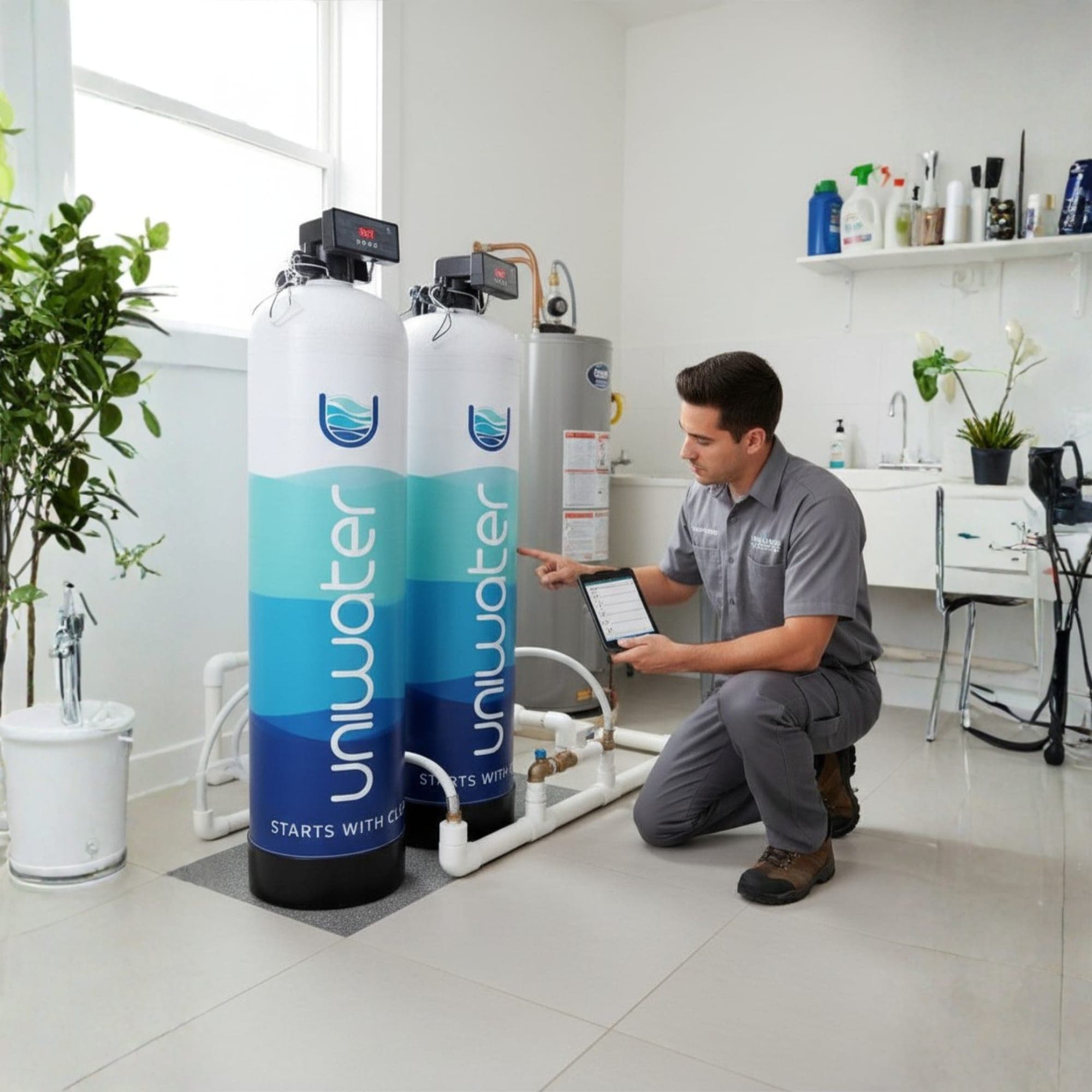
The on-site protocol is the same every visit. The engineer takes a feed-water sample at the inlet and a treated-water sample at a downstream tap. Both run through the test kit: TDS, hardness, iron, pH, free residual chlorine. The numbers go onto the tablet against the design specification for the system. Anything out of range is flagged in the report — not in code, in plain language.
After parameter testing, the engineer runs through the maintenance checklist. Backwash verification (cycles ran as scheduled, drain ran clean). Salt top-up (residual quantity weighed, refill added, amount logged). Resin inspection (capacity remaining estimated against months-since-last-regeneration). Leak check (every joint between inlet and outlet, visual). Pressure-gauge readings inlet and outlet. Internal cabinet inspection for moisture or corrosion.
Where applicable — for systems with iron pre-treatment, carbon, or UV — the engineer also checks media remaining capacity, lamp hours on the UV, and cartridge condition. Each gets a line in the report.
After
The report is generated and sent the same day. It carries the customer's install ID, the engineer's signed name, the date, the parameter readings (in and out, against spec), the maintenance actions performed, any flags raised, and the next scheduled visit date. The customer's archive grows by one PDF every month.
Across twelve months, that archive becomes a remarkable thing. Hardness in vs hardness out, charted across the year, tells the story of the resin's aging. Iron, charted, reveals seasonal shifts in the borewell. A flag raised in month seven that resolves in month eight is the visible record of a problem caught early and fixed before the customer noticed.
A documented report, same day. Parameters in. Parameters out. Work performed. Flags raised. The customer keeps the record. So do we.
What "flag raised" actually means
A flag is a specific phrase that means "this parameter is outside the design specification, and we are doing something about it within the SLA." It is not an alarm. It is the system's early-warning channel. Common flag types include resin approaching exhaustion (replacement scheduled), iron breakthrough (media regeneration accelerated), pressure drop below threshold (cleaning or component check scheduled). Comprehensive AMC commits to twenty-four-hour response on any flagged fault; Premium AMC commits to twelve.
A homeowner who has read every monthly report for three years can usually point to the month when the resin first started showing wear, the season when the borewell's iron load shifted, the year the dishwasher's feed pressure stabilised. None of this is information that any other water supplier provides. It is the discipline that decides year four.