

Groundwater in most Indian cities carries three things you might want to remove: particulate (sand, silt, oxidation products from upstream pipes), iron (dissolved as ferrous, oxidising to ferric), and hardness (calcium and magnesium ions). A drinking-water context adds residual chlorine from municipal treatment and, occasionally, arsenic in the Gangetic and Brahmaputra belts. Each contaminant has its own treatment stage. The stages have to run in the right order.
Stage one: sediment
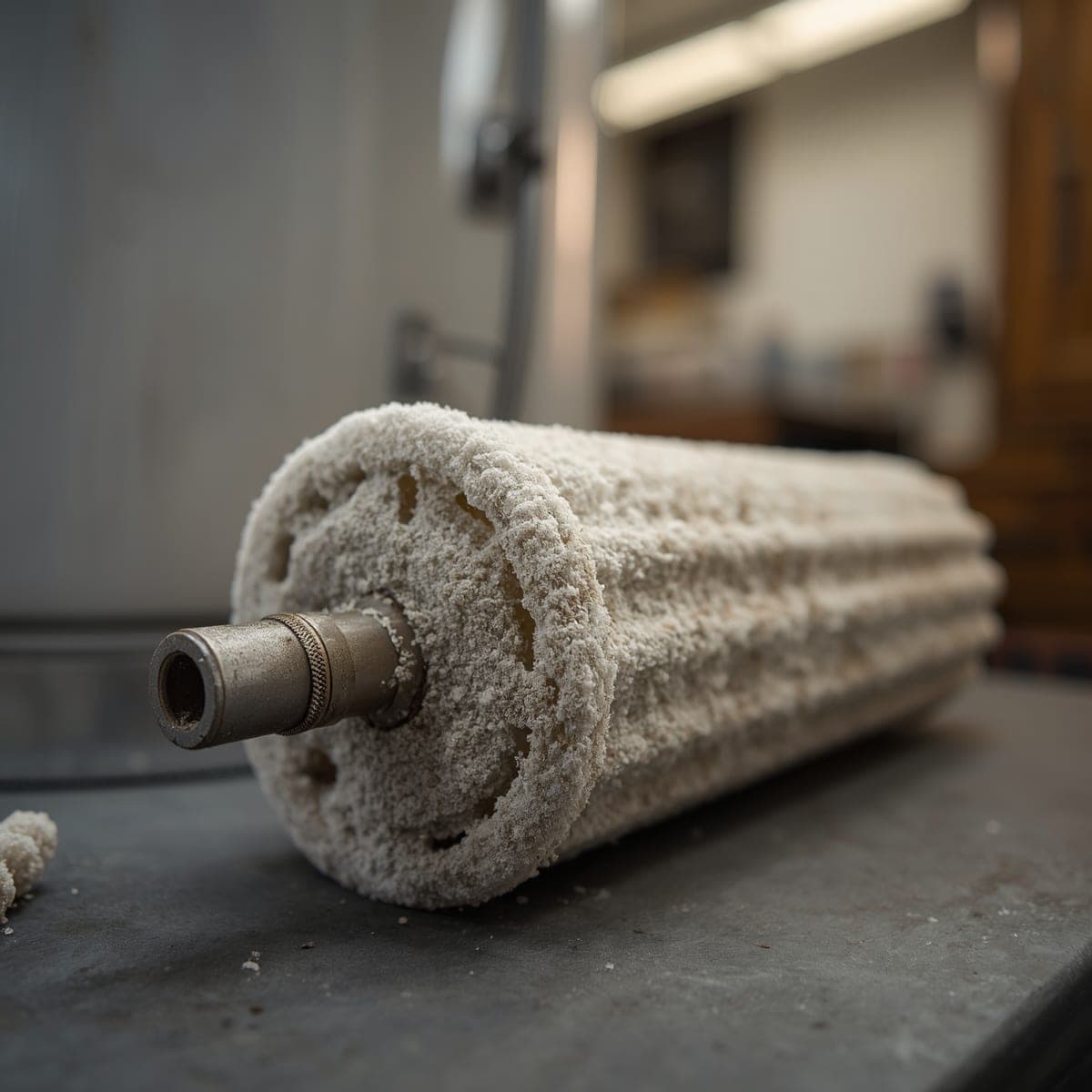
A sediment filter is the cheapest filter in the train and the one doing the most invisible work. It catches the visible particulate — silt from upstream borewell drilling, oxidation flakes from old galvanised mains, sand. Without it, the particulate scratches every valve and tears every membrane downstream. With it, the rest of the train lasts an order of magnitude longer.
Stage two: iron
Iron filtration oxidises ferrous iron to ferric and traps the ferric form in a specialised media bed. It must come before softening, because ferric iron coats and destroys softening resin in months. It must come after sediment, because particulate clogs the iron media too. This is the textbook order.
Stage three: carbon
Activated carbon adsorbs residual chlorine, the summer chemical taste, and organic matter. Chlorine, while necessary for municipal disinfection, ages CP fittings, gaskets, and rubber seals when it stays in the supply long-term. Carbon strips it without affecting the minerals that follow. Carbon also protects softening resin from chlorine oxidation, which would otherwise gradually degrade capacity.
Stage four: softening
Softening is the decisive stage — the one that homeowners actually feel. Ion-exchange resin swaps calcium and magnesium for sodium. The water feels different. Soap lathers. Hair dries softer. Skin stops feeling tight after a shower. Geyser scaling slows to a stop. By the time water reaches this stage, the resin is protected from the three things that would otherwise destroy it: particulate, iron, and chlorine.
The wrong sequence is worse than no sequence. A softener placed first burns through resin and convinces the homeowner the system is broken.
When the order changes
There are two cases where the order changes. The first is a borewell with no measurable iron and no chlorine — the carbon and iron stages can be omitted, leaving sediment plus softening. The second is an industrial application where downstream RO membranes need protection from hardness scaling — the order becomes sediment, carbon, softening, RO, with optional pre-RO cartridges.
Residential homeowners do not need to memorise these variations. They need an engineer who does. The order follows from the water test, every time.